
Exam Name: Administering Relational Databases on Microsoft Azure (DP-300 Korean Version)
Certification Provider: Microsoft
Corresponding Certification: Microsoft Azure

Over 66966+ Satisfied Customers
Instant Download Microsoft : DP-300 Korean Questions & Answers

Check Updated on: Nov 27, 2026
No. of Questions: 434 Questions & Answers with Exam Engine
Download Limit: Unlimited
Instant Download: Upon successful payment, Our systems will automatically send the product you have purchased to your mailbox by email. (If not received within 12 hours, please contact us. Note: don't forget to check your spam.)
100% Money Back Guarantee
Pass4Leader has an unprecedented 99.6% first time pass rate among our customers.  We're so confident of our products that we provide no hassle product exchange.
- Best exam practice material
- Three formats are optional
- 10+ years of excellence
- 365 Days Free Updates
- Learn anywhere, anytime
- 100% Safe shopping experience
DP-300 Korean PDF Practice Q&A's
- Printable DP-300 Korean PDF Format
- Prepared by Microsoft Experts
- Instant Access to Download DP-300 Korean PDF
- Study Anywhere, Anytime
- 365 Days Free Updates
- Free DP-300 Korean PDF Demo Available
- Download Q&A's Demo
- Total Questions: 434
- Updated on: Nov 27, 2026
- Price: $79.00
DP-300 Korean Desktop Test Engine
- Installable Software Application
- Simulates Real DP-300 Korean Exam Environment
- Builds DP-300 Korean Exam Confidence
- Supports MS Operating System
- Two Modes For DP-300 Korean Practice
- Practice Offline Anytime
- Software Screenshots
- Total Questions: 434
- Updated on: Nov 27, 2026
- Price: $79.00
DP-300 Korean Online Test Engine
- Online Tool, Convenient, easy to study.
- Instant Online Access DP-300 Korean Dumps
- Supports All Web Browsers
- DP-300 Korean Practice Online Anytime
- Test History and Performance Review
- Supports Windows / Mac / Android / iOS, etc.
- Try Online Engine Demo
- Total Questions: 434
- Updated on: Nov 27, 2026
- Price: $79.00
Reliable after-sale service
With our motto "Sincerity and Quality", we will try our best to provide the big-league DP-300 Korean exam questions for our valued customers like you. Our company emphasizes the interaction with customers. We not only attach great importance to the quality of Administering Relational Databases on Microsoft Azure (DP-300 Korean Version) exam, but also take the construction of a better after-sale service into account. It's our responsibility to offer instant help to every user. If you have any question about Administering Relational Databases on Microsoft Azure (DP-300 Korean Version) exam, please do not hesitate to leave us a message or send us an email. Our customer service staff will be delighted to answer your questions.
Plan & Implement the HADR Environment: 15-20%
- Use Database Tools, Platform, and OS to Configure HA/DR: This module measures the students’ skills in configuring replication, auto-failover groups, Availability Group listener, and creating Availability Group, among others.
- Use Database Tools to Perform Backup & Restore: This domain covers competence in performing database backup/restore with options and database restore to specific point-in-time.
- Suggest the Appropriate HADR Strategy for Data Platform Solutions: The candidates need the skills in evaluating HADR for hybrid-deployments and Azure-specific HADR solutions.
- Test the HADR Strategy with Platform, Database Tools, and OS: This subject area requires your skills in testing HA with failover and DR with restore or failover.
Microsoft DP-300 Exam Syllabus Topics:
| Topic | Details |
|---|---|
Plan and Implement Data Platform Resources (15-20%) | |
| Deploy resources by using manual methods | -deploy database offerings on selected platforms -configure customized deployment templates -apply patches and updates for hybrid and IaaS deployment |
| Recommend an appropriate database offering based on specific requirements | -evaluate requirements for the deployment -evaluate the functional benefits/impact of possible database offerings -evaluate the scalability of the possible database offering - evaluate the HA/DR of the possible database offering -evaluate the security aspects of the possible database offering |
| Configure resources for scale and performance | -configure Azure SQL Database for scale and performance -configure Azure SQL managed instances for scale and performance -configure SQL Server in Azure VMs for scale and performance -calculate resource requirements -evaluate database partitioning techniques, such as database sharding -set up SQL Data Sync |
| Evaluate a strategy for moving to Azure | -evaluate requirements for the migration -evaluate offline or online migration strategies -evaluate requirements for the upgrade -evaluate offline or online upgrade strategies |
| Implement a migration or upgrade strategy for moving to Azure | -implement an online migration strategy -implement an offline migration strategy -implement an online upgrade strategy -implement an offline upgrade strategy |
Implement a Secure Environment (15-20%) | |
| Configure database authentication by using platform and database tools | -configure Azure AD authentication -create users from Azure AD identities -configure security principals |
| Configure database authorization by using platform and database tools | -configure database and object-level permissions using graphical tools -apply principle of least privilege for all securables |
| Implement security for data at rest | -implement Transparent Data Encryption (TDE) - implement object-level encryption -implement Dynamic Data Masking -implement Azure Key Vault and disk encryption for Azure VMs |
| Implement security for data in transit | -configure server and database-level firewall rules -implement Always Encrypted |
| Implement compliance controls for sensitive data | -apply a data classification strategy -configure server and database audits -implement data change tracking -perform a vulnerability assessment |
Monitor and Optimize Operational Resources (15-20%) | |
| Monitor activity and performance | -prepare an operational performance baseline -determine sources for performance metrics -interpret performance metrics - configure and monitor activity and performance at the infrastructure, server, service, and database levels |
| Implement performance-related maintenance tasks | -implement index maintenance tasks -implement statistics maintenance tasks -configure database auto-tuning -manage storage capacity |
| Identify performance-related issues | - configure Query Store to collect performance data -identify sessions that cause blocking -assess growth/fragmentation of databases and logs -assess performance-related database configuration parameters |
| Configure resources for optimal performance | -configure storage and infrastructure resources -configure server and service account settings for performance -configure Resource Governor for performance |
| Configure a user database for optimal performance | -implement database-scoped configuration -configure compute resources for scaling -configure Intelligent Query Processing (IQP) |
Optimize Query Performance (5-10%) | |
| Review query plans | -determine the appropriate type of execution plan -identify problem areas in execution plans -extract query plans from the Query Store |
| Evaluate performance improvements | - determine the appropriate Dynamic Management Views (DMVs) to gather query performance information -identify performance issues using DMVs -identify and implement index changes for queries -recommend query construct modifications based on resource usage -assess the use of hints for query performance |
| Review database table and index design | -identify data quality issues with duplication of data -identify normal form of database tables -assess index design for performance -validate data types defined for columns -recommend table and index storage including filegroups -evaluate table partitioning strategy - evaluate the use of compression for tables and indexes |
Perform Automation of Tasks (10-15%) | |
| Create scheduled tasks | -manage schedules for regular maintenance jobs -configure multi-server automation -configure notifications for task success/failure/non-completion |
| Evaluate and implement an alert and notification strategy | -create event notifications based on metrics -create event notifications for Azure resources -create alerts for server configuration changes -create tasks that respond to event notifications |
| Manage and automate tasks in Azure | -perform automated deployment methods for resources -implement policies by using automated evaluation modes |
Plan and Implement a High Availability and Disaster Recovery (HADR) Environment (15-20%) | |
| Recommend an HADR strategy for a data platform solution | -recommend HADR strategy based on RPO/RTO requirements -evaluate HADR for hybrid deployments -evaluate Azure-specific HADR solutions -identify resources for HADR solutions |
| Test an HADR strategy by using platform, OS, and database tools | -test HA by using failover -test DR by using failover or restore |
| Perform backup and restore a database by using database tools | - perform a database backup with options - perform a database restore with options -perform a database restore to a point in time -configure long-term backup retention |
| Configure HA/DR by using OS, platform, and database tools | -configure replication -create anAlways On Availability Group -configure auto-failover groups -integrate a database into an Availability Group - configure quorum options for a Windows Server Failover Cluster -configure an Availability Group listener |
Perform Administration by Using T-SQL (10-15%) | |
| Examine system health | -evaluate database health using DMVs -evaluate server health using DMVs -perform database consistency checks by using DBCC |
| Monitor database configuration by using T-SQL | -assess proper database autogrowth configuration -report on database free space -review database configuration options |
| Perform backup and restore a database by using T-SQL | -prepare databases for Always On Availability Groups -perform transaction log backup -perform restore of user databases -perform database backups with options |
| Manage authentication by using T-SQL | -manage certificates -manage security principals |
| Manage authorization by using T-SQL | -configure permissions for users to access database objects -configure permissions by using custom roles |
High Quality and Efficiency
Most experts agree that the best time to ask for more dough is after you feel your DP-300 Korean performance has really stood out. To become a well-rounded person, reducing your academic work to a concrete plan made up of concrete actions allows you to streamline and gain efficiency, while avoiding pseudo work and guilt. Our DP-300 Korean guide materials: Administering Relational Databases on Microsoft Azure (DP-300 Korean Version) provide such a learning system where you can improve your study efficiency to a great extent. During the process of using our study materials, you focus yourself on the exam bank within the given time, and we will refer to the real exam time to set your DP-300 Korean practice time, which will make you feel the actual exam environment and build up confidence. Every question from our study materials is carefully elaborated and the content involves the professional qualification certificate examination. We believe under the assistance of our DP-300 Korean practice quiz, passing the exam and obtain related certificate are not out of reach.
99% pass rate
You may doubt about such an amazing data, which is unimaginable in this industry. But our DP-300 Korean exam questions have made it. You can imagine how much efforts we put into and how much we attach importance to the performance of our study materials. We use the 99% pass rate to prove that our practice materials have the power to help you go through the exam and achieve your dream. Most candidates show their passion on our DP-300 Korean guide materials: Administering Relational Databases on Microsoft Azure (DP-300 Korean Version), because we guarantee all of the customers, if they unfortunately fail the exam, they will receive a full fund or a substitution such as another set of study materials of our company. We treat our customers in good faith and sincerely hope them succeed in getting what they want with our DP-300 Korean practice quiz.
As we enter into such a competitive world, the hardest part of standing out from the crowd is that your skills are recognized then you will fit into the large and diverse workforce. The Administering Relational Databases on Microsoft Azure (DP-300 Korean Version) certification is the best proof of your ability. However, it's not easy for those work officers who has less free time to prepare such an exam, and people always feel fear of the unknown thing and cannot handle themselves with a sudden change. However, our DP-300 Korean exam questions can stand by your side. And we are determined to devote ourselves to serving you with the superior study materials. Here are some features of our products, you can understand in detail and make a choice.
Microsoft Administering Relational Databases on Microsoft Azure (DP-300 Korean Version) Sample Questions:
Azure IoT 허브에서 데이터를 스트리밍하기 위한 변칙 검색 솔루션을 설계하고 있습니다.
솔루션은 다음 요구 사항을 충족해야 합니다.
- 출력을 Azure Synapse로 보냅니다.
- 시계열 데이터의 급증과 하락을 식별합니다.
- 개발 및 구성 노력을 최소화합니다.
솔루션에 어떤 것을 포함해야 합니까?
- A. Azure SQL 데이터베이스
- B. Azure Databricks
- C. Azure Stream Analytics
Correct Answer: C 🗳️
Explanation: Only visible for Pass4Leader members. You can sign-up / login (it's free).
과제 3
dbl에 대해 실행되는 모든 쿼리가 쿼리 저장소에 기록되도록 해야 합니다.
Correct Answer:
See the explanation part for the complete Solution.
Explanation:
To ensure that all queries executed against dbl are captured in the Query Store, you need to enable the Query Store feature for the database and set the query capture mode to ALL. The Query Store feature provides you with insight on query plan choice and performance for Azure SQL Database1. The query capture mode controls whether all queries or only a subset of queries are tracked2.
Here are the steps to enable the Query Store and set the query capture mode to ALL for the database dbl:
Using the Azure portal:
Go to the Azure portal and select your Azure SQL Database server.
Select the database dbl and click on Query Performance Insight in the left menu.
Click on Configure Query Store and turn on the Query Store switch.
In the Query Capture Mode dropdown, select All and click on Save.
Using Transact-SQL statements:
Connect to the Azure SQL Database server and the database dbl using SQL Server Management Studio or Azure Data Studio.
Run the following command to enable the Query Store for the database: ALTER DATABASE dbl SET QUERY_STORE = ON; Run the following command to set the query capture mode to ALL for the database: ALTER DATABASE dbl SET QUERY_STORE (QUERY_CAPTURE_MODE = ALL); These are the steps to ensure that all queries executed against dbl are captured in the Query Store.
Microsoft SQL Server 2017 서버에 5개의 데이터베이스가 있습니다.
데이터베이스를 Azure로 마이그레이션할 계획입니다.
다음 요구 사항을 충족하는 솔루션을 추천해 주셔야 합니다.
* 워크로드 수요에 따라 컴퓨팅 성능을 자동으로 확장합니다.
* 초 단위 요금제를 제공합니다
권장 사항에 무엇을 포함해야 할까요? 답변하려면 답변란에서 적절한 옵션을 선택하세요.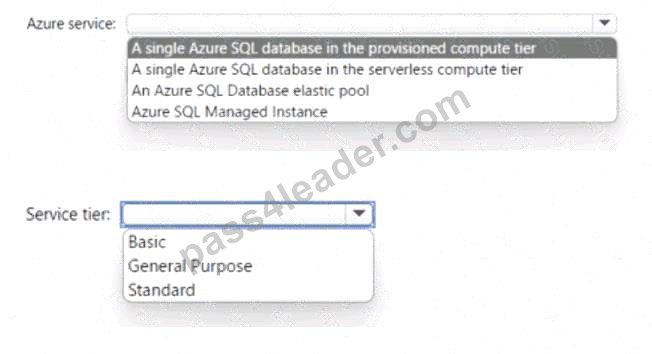
Correct Answer:

Explanation:
Basic Concept: This question tests choosing the correct Azure migration approach by matching the source platform, target service, downtime tolerance, and administrative effort.
Why the selected answer is Correct: The selected values fit this scenario because they apply the required Azure SQL configuration at the correct scope and sequence: You need to recommend a solution that meets the following requirements: Automatically scales compute based on the workload demand Provides per-second billing What should you include in the recommendation?
Why the alternate choices are Wrong: The alternate selections would either use a migration tier that does not match the downtime requirement, choose a network resource that does not support the migration path, or add an unnecessary deployment component.
사용자 이름 user1과 Azure SQL 데이터베이스 OBI가 포함된 Azure 구독이 있습니다.
DB1에 대해 장기 보존(LTR)을 구성합니다.
User1이 DBl의 LTR 백업을 삭제할 수 있도록 해야 합니다. 해결 방법은 최소 권한 원칙을 따라야 합니다. User1에게 어떤 역할을 할당해야 할까요?
- A. SQL 보안 관리자
- B. 소유자
- C. 기여자
- D. SQL Server 기여자
Correct Answer: B 🗳️
Explanation: Only visible for Pass4Leader members. You can sign-up / login (it's free).
Azure Data Lake Storage Gen 2를 사용하는 애플리케이션을 개발 중입니다.
제한된 기간 동안 특정 애플리케이션에 권한을 부여하는 솔루션을 권장해야 합니다.
추천서에 무엇을 포함해야 하나요?
- A. 공유 액세스 서명(SAS)
- B. 계정 키
- C. Azure AD(Azure Active Directory) ID
- D. 역할 할당
Correct Answer: A 🗳️
Explanation: Only visible for Pass4Leader members. You can sign-up / login (it's free).
Viewing page 1 out of 87 pages.
Viewing questions 1-5 out of 434 questions.
 0 Customer ReviewsCustomers Feedback (* Some similar or old comments have been hidden.)
Related Exams
Instant Download DP-300 Korean
After Payment, our system will send you the products you purchase in mailbox in a minute after payment. If not received within 2 hours, please contact us.
365 Days Free Updates
Free update is available within 365 days after your purchase. After 365 days, you will get 50% discounts for updating.

Money Back Guarantee
Full refund if you fail the corresponding exam in 60 days after purchasing. And Free get any another product.
Security & Privacy
We respect customer privacy. We use McAfee's security service to provide you with utmost security for your personal information & peace of mind.
