

Last NSE7_SSE_AD-25 practice test reviews: Practice Test Fortinet dumps
Try NSE7_SSE_AD-25 Free Now! Real Exam Question Answers Updated [Aug 29, 2026]
Fortinet NSE7_SSE_AD-25 Exam Syllabus Topics:
| Topic | Details |
|---|---|
| Topic 1 |
|
| Topic 2 |
|
| Topic 3 |
|
| Topic 4 |
|
NEW QUESTION # 51
In a FortiSASE secure web gateway (SWG) deployment, which two features protect against web- based threats? (Choose two.)
- A. intrusion prevention system (IPS) for web traffic
- B. SSL deep inspection for encrypted web traffic
- C. web application firewall (WAF) for web applications
- D. malware protection with sandboxing capabilities
Answer: B,D
Explanation:
SSL deep inspection allows FortiSASE to analyze encrypted web traffic for threats, while malware protection with sandboxing detects and blocks malicious files delivered through web channels.
NEW QUESTION # 52
Refer to the exhibit. An SPA service connection is experiencing connectivity problems.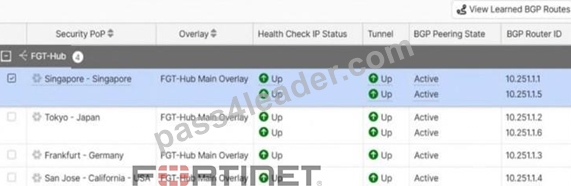
Which configuration setting should the administrator verify and correct first?
- A. BGP Peer IP
- B. Remote Gateway
- C. Authentication Method
- D. Network overlay ID
Answer: A
Explanation:
For an SPA service connection, BGP Peering is critical for route exchange between the FortiSASE POP and the FortiGate hub. If connectivity issues occur, the administrator should first verify the BGP Peer IP and ensure correct configuration, as incorrect BGP settings can prevent proper routing of SPA traffic.
NEW QUESTION # 53
A customer needs to implement device posture checks for their remote endpoints while accessing the protected server. They also want the TCP traffic between the remote endpoints and the protected servers to be processed by FortiGate.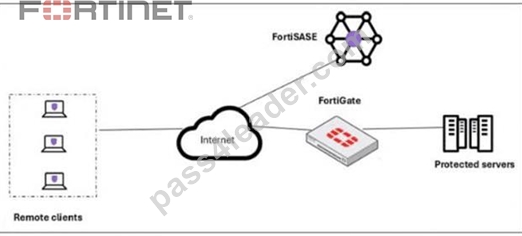
In this scenario, which two setups will achieve these requirements? (Choose two answers)
- A. Configure ZTNA tags on FortiGate.
- B. Configure private access policies on FortiSASE with ZTNA.
- C. Configure ZTNA servers and ZTNA policies on FortiGate.
- D. Configure FortiGate as a zero trust network access (ZTNA) access proxy.
Answer: C,D
Explanation:
To implement Zero Trust Network Access (ZTNA) where a FortiGate hub enforces device posture and processes traffic directly, specific architectural and configuration steps are required on the FortiGate appliance.
* ZTNA Access Proxy (B): The FortiGate must be configured as a ZTNA access proxy. In this role, the FortiGate acts as a secure gateway that mediates connections between remote users and internal applications. This setup ensures that all TCP traffic is intercepted and processed by the FortiGate, providing a direct, shortest-path connection that bypasses the FortiSASE cloud PoPs for the data plane.
* ZTNA Servers and Policies (C): Within the FortiGate configuration, administrators must define ZTNA servers (which identify the protected applications or resources) and ZTNA policies. ZTNA policies are the enforcement rules that check for valid client certificates and specific ZTNA tags (synchronized from FortiSASE) before allowing access to a resource. This configuration allows the FortiGate to perform continuous posture checks on every session.
* Posture Check Mechanism: While ZTNA tags are used, they are generally synchronized from the FortiSASE Endpoint Management Service (EMS) rather than manually configured on the FortiGate itself. This synchronization ensures the FortiGate has real-time visibility into the security posture (e.g., AV compliance, OS version) of the endpoints as reported by FortiClient.
* Analysis of Incorrect Options:
* Option A: Creating ZTNA tags manually on a FortiGate is technically possible but is not the recommended "setup" in a FortiSASE deployment, as tags are meant to be dynamically assigned by EMS and synced to the fabric.
* Option D: "Private access policies on FortiSASE" refers to the SD-WAN Secure Private Access (SPA) use case. In the SD-WAN SPA model, traffic is steered through the FortiSASE PoP first, whereas the requirement specifically asks for TCP traffic to be processed by the FortiGate using ZTNA.
NEW QUESTION # 54
How does FortiSASE hide user information when viewing and analyzing logs?
- A. By hashing data using Blowfish
- B. By encrypting data using advanced encryption standard (AES)
- C. By hashing data using salt
- D. By encrypting data using Secure Hash Algorithm 256-bit (SHA-256)
Answer: C
Explanation:
FortiSASE hides user information when viewing and analyzing logs by hashing data using salt. This approach ensures that sensitive user information is obfuscated, enhancing privacy and security.
* Hashing Data with Salt:
* Hashing data involves converting it into a fixed-size string of characters, which is typically a hash value.
* Salting adds random data to the input of the hash function, ensuring that even identical inputs produce different hash values.
* This method provides enhanced security by making it more difficult to reverse-engineer the original data from the hash value.
* Security and Privacy:
* Using salted hashes ensures that user information remains secure and private when stored or analyzed in logs.
* This technique is widely used in security systems to protect sensitive data from unauthorized access.
References:
FortiOS 7.6 Administration Guide: Provides information on log management and data protection techniques.
FortiSASE 23.2 Documentation: Details on how FortiSASE implements data hashing and salting to secure user information in logs.
NEW QUESTION # 55
In which two ways does FortiSASE help organizations ensure secure access for remote workers?
(Choose two.)
- A. It uses the identity and access management (IAM) portal to validate the identities of remote workers.
- B. It offers zero trust network access (ZTNA) capabilities.
- C. It secures traffic from endpoints to cloud applications.
- D. It uses the FortiCloud organizational units to assign endpoint profiles to remote workers.
Answer: B,C
Explanation:
FortiSASE ensures secure access for remote workers by protecting traffic between endpoints and cloud applications and enforcing ZTNA policies that validate user identity and device posture before granting access to corporate resources.
NEW QUESTION # 56
Which two statements about FortiSASE Geofencing with regional compliance are true? (Choose two.)
- A. The connection order for a regional compliance rule is always the security POP first, followed by the on-premises device.
- B. If no regional compliance rule is configured, the connection is made to the closest security POP.
- C. A regional compliance rule can connect only to an on-premises device or only to a security POP.
- D. You can configure regional compliance on the security POP or the on-premises device, not both.
Answer: B,C
Explanation:
If no regional compliance rule is configured, FortiSASE directs traffic to the closest security POP.
A regional compliance rule must specify either a security POP or an on-premises device; it cannot combine both in a single rule, ensuring traffic adheres to geographic or regulatory requirements.
NEW QUESTION # 57
What are the two key features and benefits of Fortinet SOCaaS when integrated with FortiSASE?
(Choose two.)
- A. Fortinet SOCaaS monitors only remote users, does not support log forwarding, and provides threat notifications without response guidance or expert meetings.
- B. Fortinet SOCaaS is a standalone service that monitors only FortiGate environments, provides automated patching without human analysis, and does not integrate with FortiSASE.
- C. Fortinet SOCaaS provides 24x7x365 cloud-based monitoring by Fortinet experts using AI, machine learning, and human analysis.
- D. Fortinet SOCaaS offers monitoring only during standard business hours, uses AI without human analysis, and provides annual reports without dashboards or FortiSASE integration.
- E. Fortinet SOCaaS allows for consistent security monitoring through log forwarding, offers rapid threat notifications and response guidance, and includes intuitive dashboards.
Answer: C,E
Explanation:
Fortinet SOCaaS integrated with FortiSASE delivers continuous 24x7x365 monitoring by combining AI-driven detection, machine learning, and expert human analysis to identify threats in real time. It also provides centralized visibility through dashboards, log forwarding, and actionable threat response guidance to improve detection, investigation, and remediation across the SASE environment.
NEW QUESTION # 58
An administrator must restrict endpoints from certain countries from connecting to FortiSASE.
Which configuration can achieve this?
- A. Configure geofencing to restrict access from the required countries.
- B. Configure a network lockdown policy on the endpoint profiles.
- C. Configure source IP anchoring to restrict access from the specified countries.
- D. Configure a geography address object as the source for a deny policy.
Answer: A
Explanation:
Geofencing allows the administrator to restrict or allow access to FortiSASE services based on the geographic location of the endpoints, effectively blocking connections from specified countries.
NEW QUESTION # 59
Which endpoint functionality can you configure using FortiSASE?
- A. You can configure inline sandbox to scan zero-day malware attacks.
- B. It can be applied to both SWG and VPN deployments.
- C. Site-based FortiExtender users can perform on-demand vulnerability scans.
- D. You can enable and push web filter to FortiClient endpoints.
Answer: A
Explanation:
FortiSASE supports inline sandbox integration to detect and analyze zero-day malware threats, enhancing endpoint and network security against advanced attacks.
NEW QUESTION # 60
Which service is included in a secure access service edge (SASE) solution, but not in a security service edge (SSE) solution?
- A. SWG
- B. ZTNA
- C. SD-WAN
- D. CASB
Answer: C
Explanation:
SD-WAN is a networking component included in a SASE solution but not in an SSE solution. SSE focuses solely on security services (like ZTNA, SWG, and CASB), while SASE combines both networking (e.g., SD-WAN) and security into a unified cloud-delivered service.
NEW QUESTION # 61
You are designing a new network, and the cybersecurity policy mandates that all remote users working from home must always be connected and protected. Which FortiSASE component facilitates this always-on security measure? (Choose one answer)
- A. Secure web gateway
- B. Unified FortiClient
- C. SDWAN on-ramp2
- D. Thin-branch SASE extension
Answer: B
Explanation:
In a FortiSASE environment, the Unified FortiClient agent is the critical component that fulfills the requirement for "always-on" connectivity and security for remote users.
* Persistent Encrypted Tunnels: The Unified FortiClient maintains a persistent, always-on connection to the FortiSASE infrastructure.4 This is typically achieved through an auto-connect VPN tunnel (SSL or IPsec) that initiates as soon as the user logs into their device and has internet access.
* Continuous Security Enforcement: By staying connected to a nearby FortiSASE Point of Presence (PoP), the endpoint ensures that all traffic is inspected. This allows the organization to enforce a consistent security posture-including Web Filtering, Antivirus, and Application Control-regardless of whether the user is at home, in a coffee shop, or traveling.
* Zero-Trust Integration: Beyond simple connectivity, the unified agent supports Universal ZTNA. It continuously verifies the identity of the user and the security posture of the device before granting access to specific applications, thereby satisfying modern zero-trust security mandates.
* Comparison of Other Components:
* SD-WAN on-ramp (B): Used primarily to integrate existing branch office SD-WAN networks with the SASE cloud for private application access.
* Secure Web Gateway (C): While a feature of the SASE PoP, the agentless SWG deployment (using PAC files) does not provide the same level of "always-on" persistent tunnel protection as the FortiClient agent.
* Thin-branch SASE extension (D): Focused on securing small branch locations (using FortiAP or FortiExtender) where individual client agents may not be deployed on every device.
NEW QUESTION # 62
When accessing the FortiSASE portal for the first time, an administrator must select data center locations for which three FortiSASE components? (Choose three.)
- A. Identity & access management (IAM)
- B. Logging
- C. Sandbox
- D. Endpoint management
- E. Points of presence
Answer: B,C,D
Explanation:
When first accessing the FortiSASE portal, the administrator must select data center locations for endpoint management, logging, and sandbox services to ensure optimized performance and compliance with data residency requirements.
NEW QUESTION # 63
What are the key differences between the FortiSASE BGP per overlay and BGP on loopback routing design methods? (Choose one answer)
- A. BGP per overlay is used for loopback interfaces to reduce routes, while BGP on loopback is the default method requiring separate iBGP sessions for each spoke.
- B. BGP per overlay can use separate iBGP sessions for each spoke-to-hub tunnel with mode-cfg enabled for IP address assignment, while BGP on loopback uses a single iBGP session per hub terminating on a loopback interface to simplify configuration and reduce advertised routes.
- C. BGP per overlay simplifies hub configuration without mode-cfg, while BGP on loopback establishes multiple iBGP sessions for each tunnel to increase advertised routes.
- D. BGP per overlay establishes a single iBGP session per hub on a loopback interface, while BGP on loopback requires mode-cfg for IP address assignment and uses multiple iBGP sessions per tunnel.
Answer: B
Explanation:
FortiSASE supports two main routing design methods for Secure Private Access (SPA) when connecting to a FortiGate SD-WAN hub:
* BGP per Overlay (Traditional/Default Method): In this configuration, a separate iBGP session is established over every individual IPsec overlay (tunnel) between the FortiSASE PoP and the hub. These sessions terminate on the tunnel interface IP addresses. To facilitate this, the hubs typically use the IPsec VPN mode-cfg feature to dynamically assign tunnel IP addresses to the SASE PoPs. For every LAN prefix, the system generates multiple BGP routes-one for each overlay-which increases the total number of routes advertised across the network.
* BGP on Loopback (Modern Alternative): This newer design establishes only a single iBGP session between the spoke and the hub, regardless of how many physical or logical overlays (tunnels) connect them. The session is terminated on a loopback interface on both sides.
* Key Advantages of BGP on Loopback:
* Reduced Complexity: It significantly simplifies the BGP configuration because there are fewer neighbors to manage.2
* Improved Scalability: It greatly reduces the volume of routes advertised, as only a single BGP route is generated for each LAN prefix, making it the preferred choice for large-scale deployments.
* Resiliency: The BGP session remains active as long as the loopback is reachable via any of the available overlays, meaning no BGP convergence is required if a single overlay fails.
NEW QUESTION # 64
Refer to the exhibit. Which two statements about the onboarding process shown in the exhibit are true? (Choose two.)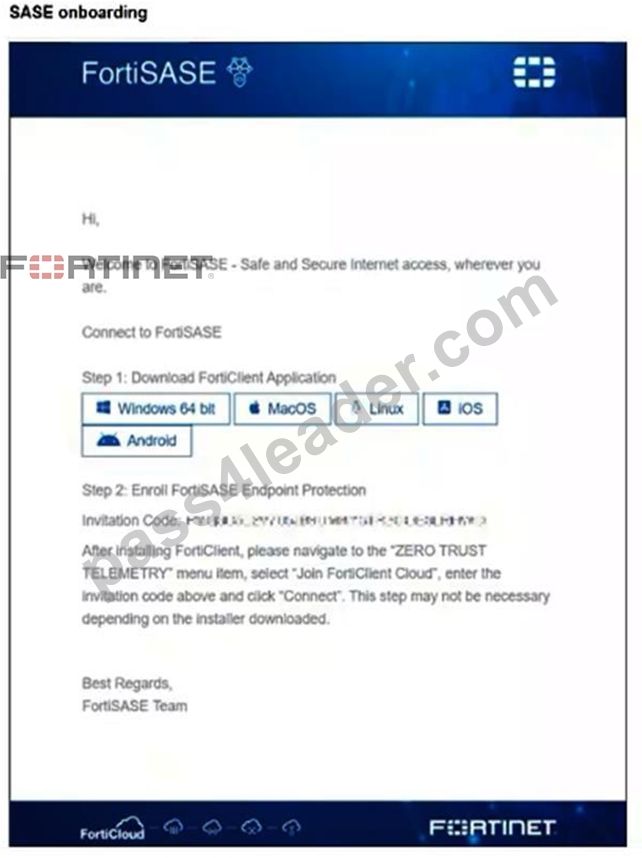
- A. This is an email from the FortiSASE platform to an end user.
- B. The invitation code must always be entered manually after installing FortiClient.
- C. The user must manually select which FortiSASE components to install during the FortiClient setup.
- D. Depending on the installer used, the invitation code step may be skipped.
Answer: A,D
Explanation:
The onboarding screen shows a FortiSASE-generated invitation message sent to the user with download links and an enrollment code. It also explicitly notes that the invitation code step "may not be necessary depending on the installer downloaded," meaning the step can be skipped in some installation methods such as preconfigured or bundled FortiClient packages.
NEW QUESTION # 65
Which two advantages does FortiSASE bring to businesses with microbranch offices that have FortiAP deployed for unmanaged devices? (Choose two.)
- A. It eliminates the requirement for an on-premises firewall.
- B. It secures internet access both on and off the network.
- C. It simplifies management and provisioning.
- D. It uses zero trust network access (ZTNA) tags to perform device compliance checks.
Answer: B,C
Explanation:
FortiSASE extends secure internet access to users regardless of their location and streamlines the management and provisioning of security policies and services for microbranch offices with unmanaged devices.
NEW QUESTION # 66
......
Get Ready to Pass the NSE7_SSE_AD-25 exam with Fortinet Latest Practice Exam : https://testoutce.pass4leader.com/Fortinet/NSE7_SSE_AD-25-exam.html