

Updated Nov-2024 Exam Materials for You to Prepare & Pass 300-630 Exam.
Pass Your 300-630 Exam at the First Try with 100% Real Exam
Cisco 300-630 exam is designed for professionals who want to validate their expertise in implementing and managing Cisco Application Centric Infrastructure (ACI) solutions. 300-630 exam is part of the CCNP Data Center certification track and is one of the advanced-level exams that require in-depth knowledge of ACI concepts, architecture, and implementation methods. 300-630 exam covers a wide range of topics, including policy-driven automation, network programmability, security, and troubleshooting.
Cisco 300-630 exam is part of the Cisco Certified Network Professional (CCNP) Data Center certification track. It is intended for candidates who have already obtained the CCNP Data Center certification or have equivalent knowledge and experience. 300-630 exam consists of 60-70 questions and candidates have 90 minutes to complete it.
NEW QUESTION # 57
A packet is routed between two endpoints on different Cisco ACI leaf switches. Which VXLAN VNID is applied to the packet?
- A. EPG
- B. VRF
- C. BD
- D. FD
Answer: B
Explanation:
When a packet is routed between two endpoints on different Cisco ACI leaf switches, the VXLAN VNID applied to the packet is the VRF (Virtual Routing and Forwarding) VNID. This VNID enables forwarding of the packet through tenant virtual routing and forwarding domains within the fabric34.
References := Cisco APIC Layer 3 Networking Configuration Guide, Release 3.x and later
NEW QUESTION # 58 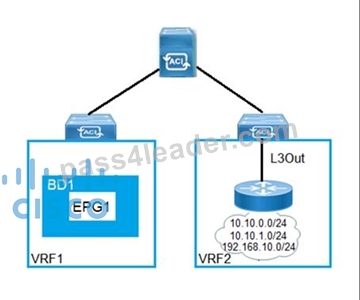
Refer to the exhibit. Drag and drop the subnets and flags from the left into the External Network Instance Profile policies on the right to create a setup that advertises only 10.10.0.0/24 and 10.10.1.0/24 prefixes in VRF1 and establishes connectivity between VRFs. Not all options are used.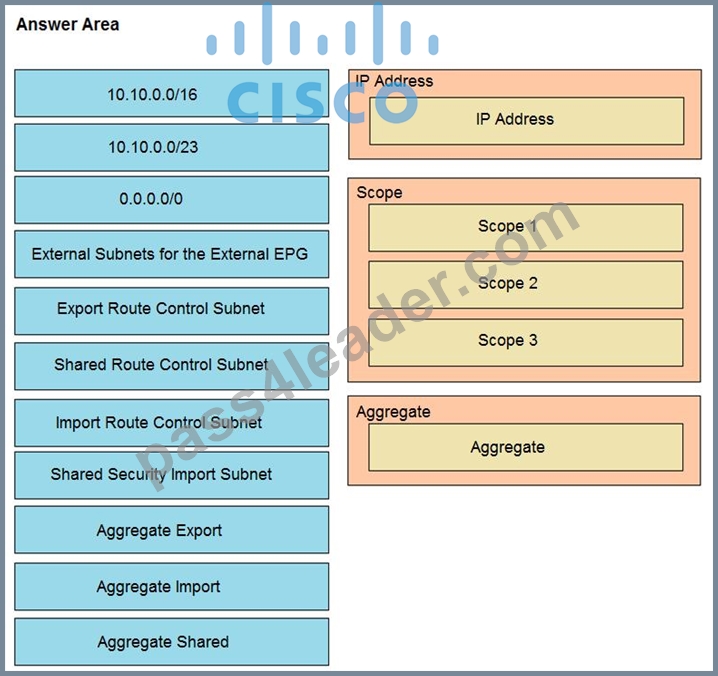
Answer:
Explanation: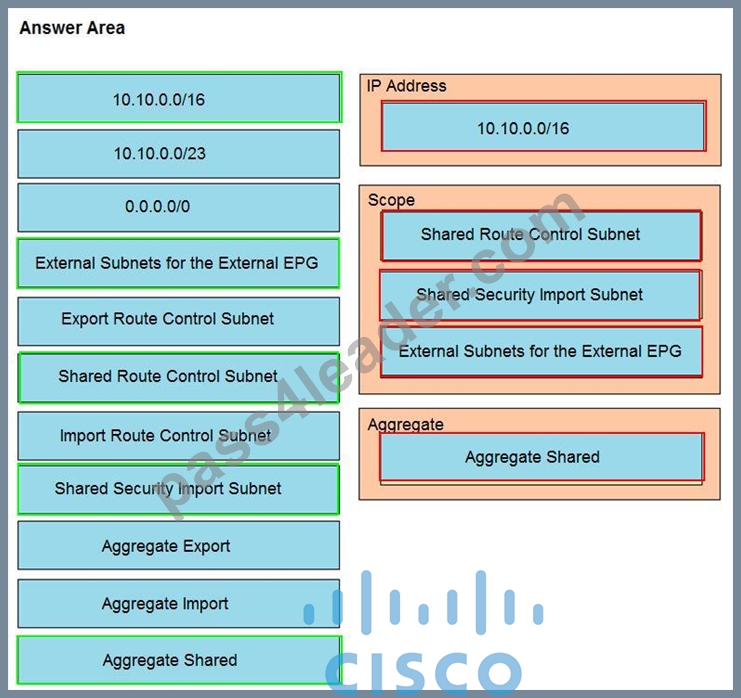
NEW QUESTION # 59
What is the advantage of implementing an active-active firewall cluster that is stretched across separate pods when anycast services are configured?
- A. Local traffic in a pod is load-balanced between the clustered firewalls.
- B. A cluster can be deployed in transparent mode across pods.
- C. The local pod anycast node is preferred by the local spines.
- D. A different MAC/IP combination can be configured for the firewall in each pod.
Answer: C
NEW QUESTION # 60
Refer to the exhibit.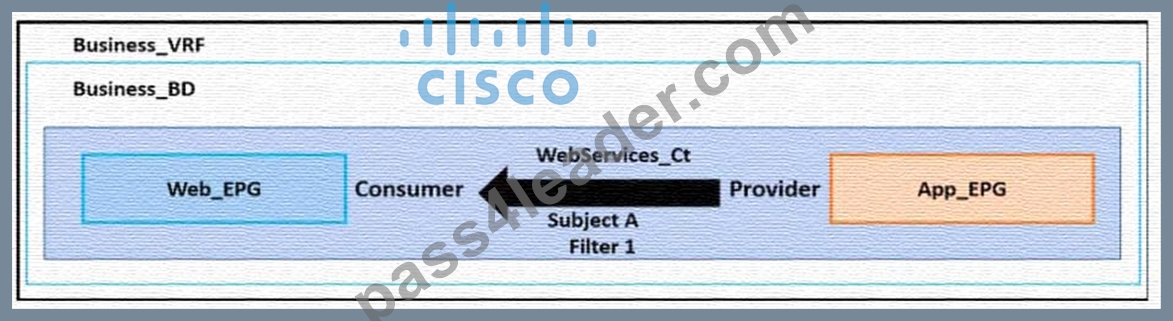
Which configuration set must be applied to filter 1 to enable SSH communication between Web_EPG to App_EPG?
- A. Apply Both Directions: Disabled Reverse Filter Ports: Disabled
- B. Apply Both Directions: Enabled Reverse Filter Ports: Disabled
- C. Apply Both Directions: Disabled Reverse Filter Ports: Enabled
- D. Apply Both Directions: Enabled Reverse Filter Ports: Enabled
Answer: B
Explanation:
To enable SSH communication between Web_EPG (Web Endpoint Group) and App_EPG (Application Endpoint Group), it's necessary to apply a configuration that allows bidirectional communication while not restricting ports based on their directionality. By enabling "Apply Both Directions" and disabling "Reverse Filter Ports," this ensures that the filter allows SSH packets to flow from Web_EPG to App_EPG and vice versa without any restrictions based on the port's direction, which is essential for establishing an SSH session. References := ( Implementing Cisco Application Centric Infrastructure Official Cert Guide )
NEW QUESTION # 61 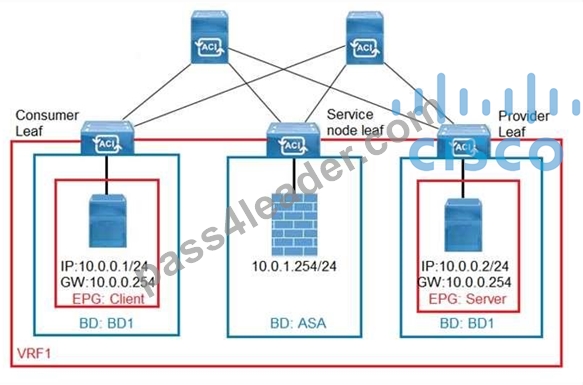
Refer to the exhibit. What must be configured in the service graph to redirect HTTP traffic between the EPG client and EPG server to go through the Cisco ASA firewall?
- A. precise filter to allow only HTTP traffic
- B. contract filter to allow ARP and HTTP
- C. permit-all contract filter
- D. contract with no filter
Answer: B
Explanation:
Section: Advanced ACI Policies and Integrations
NEW QUESTION # 62
Refer to the exhibit.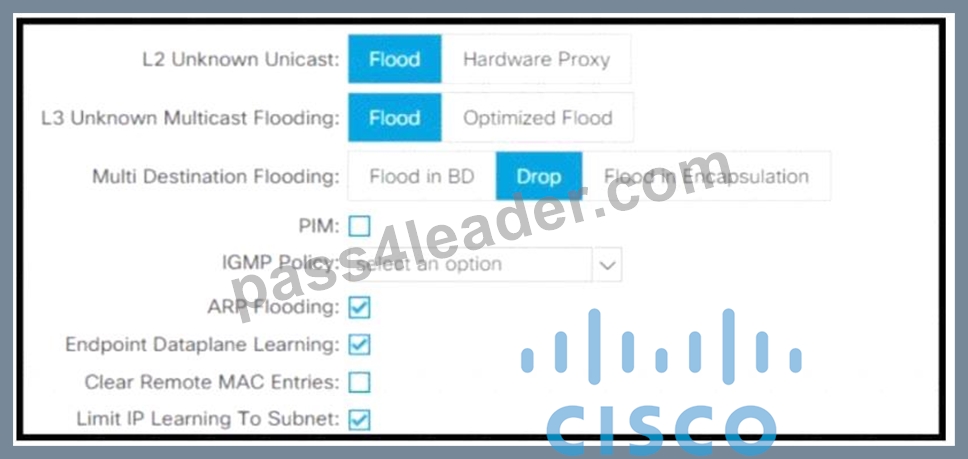
Which method does Cisco ACI fabric use to forward L2 Unknown Unicast packets?
- A. The source leaf sends the traffic to all ports in BD.
- B. Packets are dropped if dMAC is absent in COOP.
- C. The traffic is flooded using VRF Outer Multicast Group ID.
- D. Traffic is flooded to all Layer 2 ports of ACI fabric.
Answer: D
NEW QUESTION # 63
How many APICs are recommended by Cisco for a Cisco ACI fabric?
- A. 0
- B. 1
- C. 2
- D. 3
- E. 4
- F. 5
Answer: C
NEW QUESTION # 64
An organization migrates its virtualized servers from a legacy environment to Cisco ACI. VM1 is incorrectly attached to PortGroup IT|3TierApp|Web.
Which action limits IP address learning in BD1?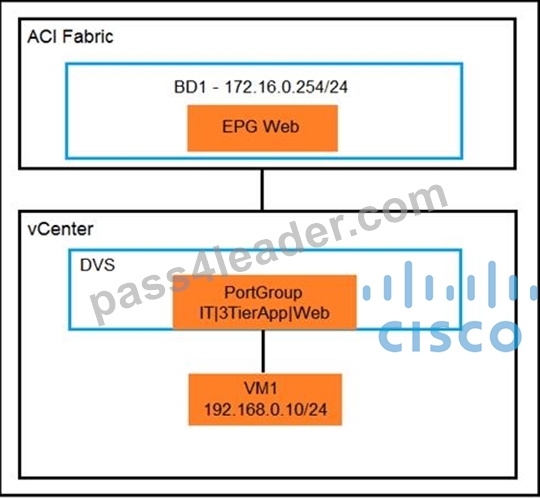
- A. Enable Enforce Subnet Check
- B. Enable GARP-based EP Move Detection Mode
- C. Enable Rouge Endpoint Control
- D. Disable Remote EP Learn
Answer: A
Explanation:
https://www.cisco.com/c/en/us/solutions/collateral/data-center-virtualization/application-centric- infrastructure/white-paper-c11-739989.html
NEW QUESTION # 65
Refer to the exhibit. New e-commerce software is deployed on Cisco ACI fabric. The environment must meet these requirements:
- The overall number of contracts must be reduced by reusing the
existing contracts within a VRF when possible.
- The e-commerce software must communicate only with software EPGs that are part of the same ANP.
- The e-commerce software must be prevented from communicating with
applications in different ANPs.
Which scope must be selected to meet these requirements?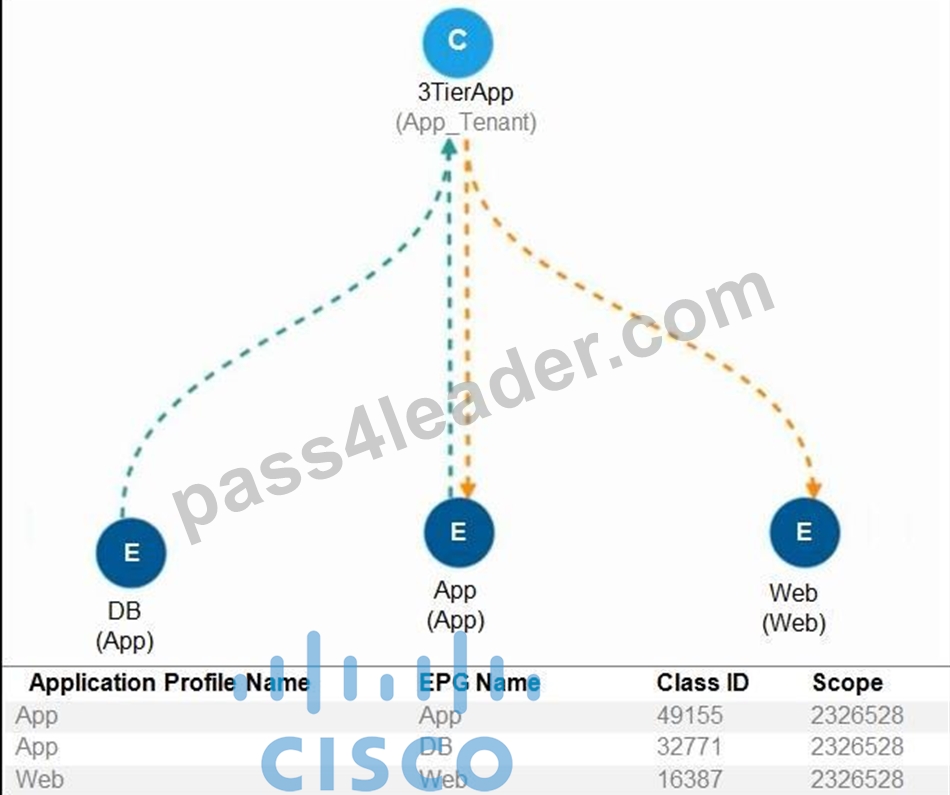
- A. Tenant
- B. Application Profile
- C. Global
- D. Endpoint Group
Answer: B
NEW QUESTION # 66
A host that is connected to a Cisco ACI fabric leaf switch sends an ARP request. Which transmission method does the ingress switch use to send the ARP requests?
- A. unicast
- B. multicast
- C. broadcast
- D. anycast
Answer: C
Explanation:
When a host connected to a Cisco ACI fabric leaf switch sends an ARP request, the ingress leaf switch uses a broadcast transmission method to send the ARP requests. This is because ARP requests are meant to discover the MAC address associated with a specific IP address within the same network broadcast domain. The ingress leaf switch does not know the destination MAC address, so it broadcasts the ARP request to all devices within the broadcast domain1.
References := ( Implementing Cisco Application Centric Infrastructure Official Cert Guide )
NEW QUESTION # 67
Refer to the exhibit. A Cisco ACI fabric must be integrated with VMware. Leaf1 and Leaf2 are connected to S1 using a VPC. The object VMware Virtual Distributed switch VPC Policy group type has been created in the fabric. Which mode must be set for the port-channel policy to allow the failover and the full use of the bandwidth in both directions?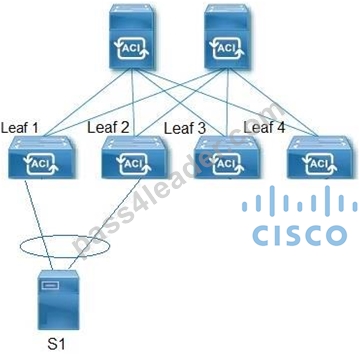
- A. Static channel - Mode On
- B. Link Aggregation Control Protocol
- C. MAC Pinning
- D. Explicit failover order
Answer: A
NEW QUESTION # 68
An engineer is implementing the Cisco ACI fabric but is experiencing loops detected from endpoints. When the issue was investigated, it was discovered that the packets are received with the same source IP address but from different leaf switch ports. The engineer must prevent the issue from happening in the future and make sure that the port is brought back up if it was disabled due to the loop discovered. Which set of actions must be taken to meet these requirements?
- A. Enable the rogue endpoint and set the Error Disabled Recovery Policy
- B. Enable the remote endpoint limit and set the Interface override
- C. Enable the enforce endpoint check and set the Rouge EP detection interval
- D. Enable reverse path forwarding and set the Hold Interval
Answer: A
Explanation:
https://www.cisco.com/c/en/us/td/docs/switches/datacenter/aci/apic/sw/3- x/basic_config/b_APIC_Basic_Config_Guide_3_x/b_APIC_Basic_Config_Guide_3_x_chapter_01
11.html#id_65514
NEW QUESTION # 69
Which two components must be configured as stretched to establish intra-VRF communication between two EPGs that are deployed in different sites and different bridge domains? (Choose two.)
- A. bridge domain
- B. EPG
- C. contract
- D. application profile
- E. tenant
Answer: A,B
Explanation:
To establish intra-VRF communication between two EPGs deployed across different sites with different bridge domains, stretching the bridge domain and EPG components is necessary. Option D, "bridge domain," and Option E, "EPG," must be configured as stretched to facilitate communication across different sites within the same VRF. References:= Implementing Cisco Application Centric Infrastructure Official Cert Guide
NEW QUESTION # 70
Refer to the exhibit.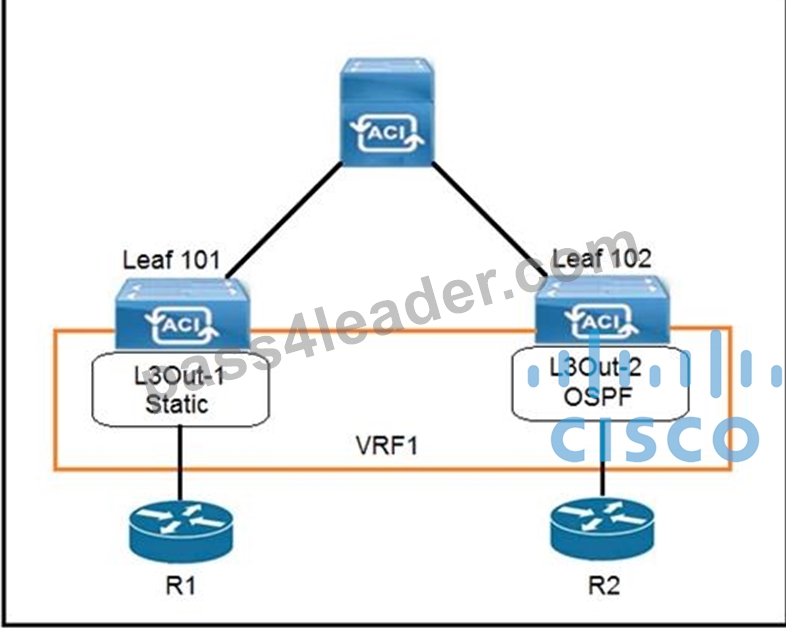
The 0.0.0.0/0 is configured as a default static route on L3Out-1. Which action should be taken for the 0.0.0.0/0 prefix to advertise out on L3Out-2 OSPF?
- A. Enable Shared Route Control Subnet
- B. Enable Aggregate Export Subnet
- C. Enable Shared Security Import Subnet
- D. Enable Export Route Control Subnet
Answer: B
NEW QUESTION # 71
An engineer must implement an L30ut within a tenant to allow the reachability to services outside of the Cisco ACI fabric. The requirement is to allow communication from the EPGs in the same VRF to the external services and save TCAM resource utilization. Which contract insertion method must be used to meet these requirements?
- A. Provider: each service EPGs Consumer: L30ut external EPGs
- B. Provider: L30ut external EPGs Consumer: each service EPGs
- C. Provider: each service EPGs Consumer: vzAny inside the VRF
- D. Provider: L30ut external EPGs Consumer: vzAny inside VRF
Answer: C
NEW QUESTION # 72
What is a characteristic of a stretched bridge domain solution between Cisco ACI sites with Layer 2 flood disabled?
- A. Headend replication is used for BUM traffic between sites.
- B. The application profile that is associated to the bridge domain have local significance in each site.
- C. The tenant and VRF that associated to the bridge domain have local significance in each site.
- D. IP mobility is ensured between sites for disaster recovery.
Answer: C
Explanation:
Section: Multisite
Explanation/Reference:
NEW QUESTION # 73
An engineer must migrate servers from a legacy data center infrastructure to a Cisco ACI fabric. Drag and drop the steps from the left into the order that they must be completed on the right to ensure the least amount of downtime.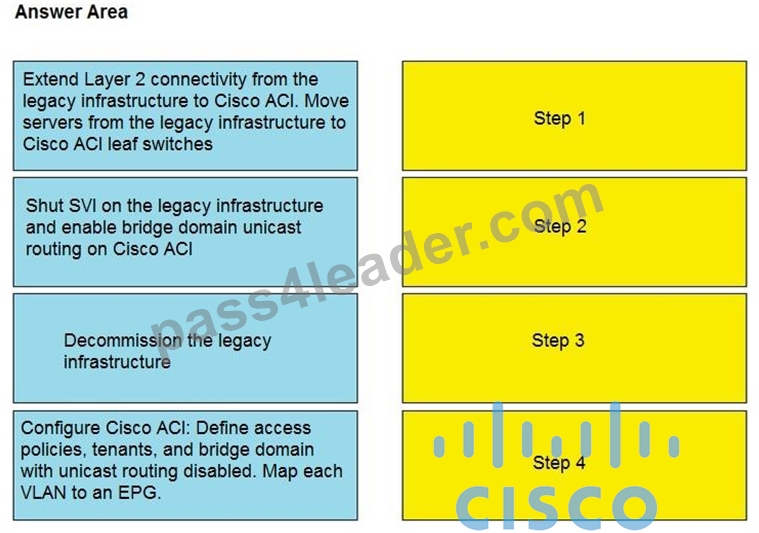
Answer:
Explanation: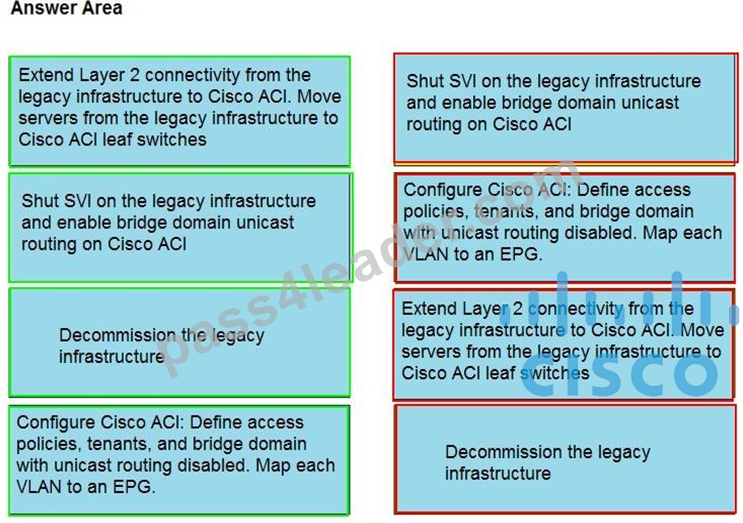
NEW QUESTION # 74
Refer to the exhibit. A customer experiences resource overconsumption on one of its border leaf switches. Which action should be taken to reduce the consumption on this switch?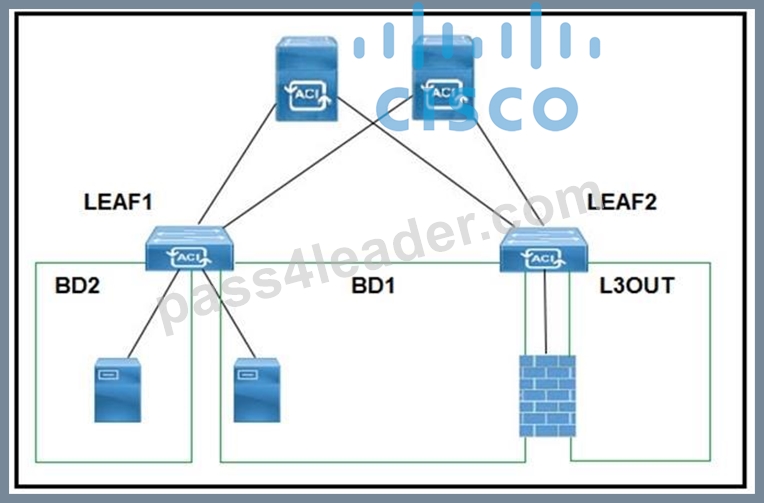
- A. Disable IP Data Plane Learning
- B. Disable Remote EP Learning
- C. Disable VRF Policy Control Enforcement
- D. Migrate L3Outs to another switch
Answer: B
NEW QUESTION # 75
A customer plans to deploy a Cisco ACI Multi-Pod deployment. Which two features must be implemented on the IPN switches?
- A. * Enable BIDIR-PIM.
* Configure a minimum multicast range of/15. - B. * Configure PIM anycast RP.
* Configure a maximum multicast range of /15. - C. * Enable BIDIR-PIM.
* Configure a maximum multicast range of/23. - D. * Configure PIM anycast RP.
* Configure a minimum multicast range of 123.
Answer: D
Explanation:
Configuring Protocol Independent Multicast (PIM) anycast RP allows for efficient multicast traffic routing between pods by having multiple Rendezvous Points (RPs) share the same IP address. A maximum multicast range of /15 provides sufficient address space to support the scale of multicast traffic typically required in such deployments. References := (Implementing Cisco Application Centric Infrastructure Official Cert Guide)
NEW QUESTION # 76
......
Updated 300-630 Certification Exam Sample Questions: https://testoutce.pass4leader.com/Cisco/300-630-exam.html